The least intrusive response comes first
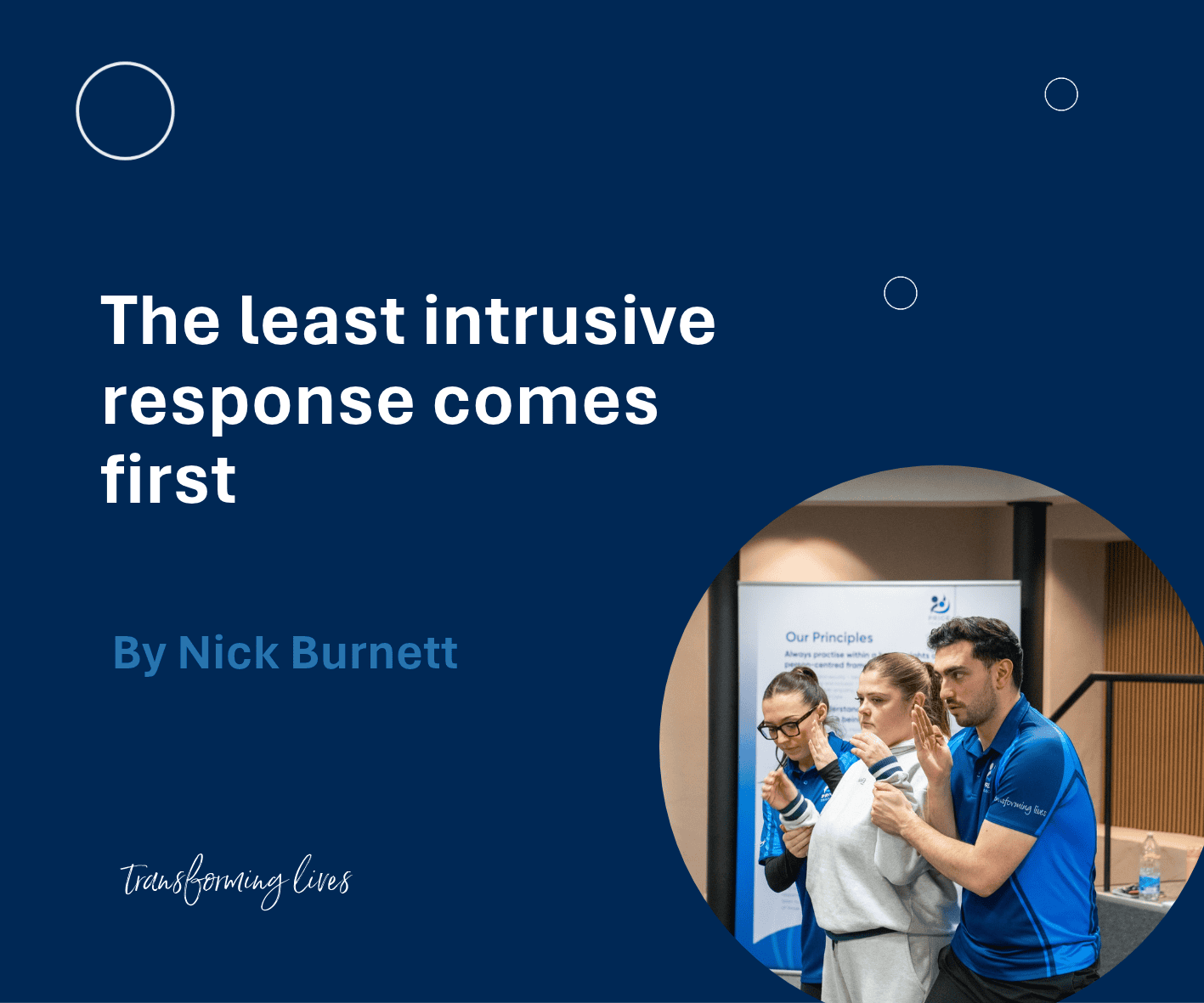
By Nick Burnett
Ask a group of staff what they remember from their last behaviour support course and many will name the physical techniques. That’s understandable, because those moments feel highest stakes and they’re often the part of the day people worry about most. They should also be the moments we need least often.
Wherever you work, whether that’s a school, a children’s home, a hospital ward or an adult disability service, the expectation now points the same way. Prevention comes first, restrictive practices are kept for situations of immediate risk, and every incident becomes something we learn from afterwards. Policy in the UK, Australia and New Zealand has been moving in this direction for some time, and I’d suggest most practitioners welcome it. The harder question is whether the way we prepare staff has kept pace.
The four-step continuum
I find it helps to picture a continuum where the least intrusive response always comes first. Each step asks something different of the people doing the work.
1. Prevention and early intervention
This is where we get to know the person well enough to understand what their behaviour might be communicating. Behaviour that looks like defiance can turn out to be fear, or a reaction to a routine that changed without anyone explaining why. Prevention also means looking hard at the environment. Noise and crowding add to distress for many people, and small adjustments here often prevent far more than any technique taught later in the day.
2. De-escalation and diffusion
This covers how you use your voice and your body, and when to say less or step back altogether. With your own heart rate climbing, these skills are hard to reach for, which is why staff need to practise them in realistic scenarios drawn from the settings they work in.
3. A safe response in a crisis
This is for situations where someone is at immediate risk of harm. It calls for techniques that have been assessed for safety and suit the setting. Nobody should go into this work without knowing how to keep people safe at the worst moment. It sits third because good work in the first two steps makes it less likely to be needed.
4. Support and reflection afterwards
This is the step most likely to get squeezed when a shift is busy. Recovery comes first, for the person supported and for the staff involved, because everyone has been through something. Then comes the debrief, which asks what happened and what the team will change. Over time, the patterns in incident records start to show what needs to change in steps one and two.
Where the skill lives
In my experience, most of the skill sits in the first two steps, and the fourth is where culture shifts over time. If a team finds itself relying on the crisis response, it’s usually worth looking back at what happened earlier in the sequence. When I’ve done this with teams, the answers have tended to sit in time, staffing, the plan itself or a gap in training nobody had noticed.
Across the four sectors
You’ll recognise this in very different places:
- Education and Schools: a teacher notices a student’s distress building through the morning and changes the plan for the afternoon before it reaches crisis.
- Children’s Services: staff in residential care who’ve completed trauma training need to bring it into the moment itself, which takes practice as well as knowledge.
- Health: on a ward, it might mean giving someone in acute distress space and time and adjusting the environment around them.
- Adult Services: progress shows when the strategies in a behaviour support plan become everyday practice and incident records show restrictive practices coming down.
How this sits with PRICE
PRICE was set up in 1993 by practitioners who were worried about how children in residential care were being treated, and the four steps reflect that history. Prevention draws on positive behaviour support and on what the people we support tell us, because they shape what staff learn. De-escalation gets a large share of training time, practised in scenarios built around each setting. The physical techniques have been assessed by biomechanics and anatomy specialists, and none of them rely on pain. Post-incident support and reflective practice are taught as their own section, alongside recording and data analysis, so incident records can show staff what to change earlier on. Trauma and brain science run throughout the training.
What to check
If you lead a team or commission training, a few things are worth checking:
- How your current training time splits across the four steps. If the crisis response takes up most of the day, ask why.
- Whether debrief is taught and practised as a skill or left to whoever happens to be on shift.
- Whether incident reviews look back at what was happening an hour earlier.
- What the people you support, and their families, say helps them early on.
If you mapped your last round of training against those four steps, where would most of the time have gone?
Share this story